Langer See
The Boys in the BoatLanger See, at Grünau southeast of Berlin, was both a historic center of German water sports and the setting for the Olympic rowing races of 1936. Its geography became a direct competitive force: protected lanes near shore contrasted sharply with exposed outer lanes, and wind across the open water threatened to impose a substantial disadvantage on some crews. The lake’s purpose-built Olympic facilities made it a stage for international sport, but its surrounding rowing community had already been transformed by the exclusion and displacement of Jewish members. In the book’s closing return to Grünau, the course remains recognizably intact, holding together the memory of the race and the history that surrounded it.
Setting and Rowing History
Langer See is described as a long, narrow lake fed by the Dahme River, where Berlin’s suburbs gave way to meadows and dark woodland. Its deep blue water had been the center of the city’s water sports for generations. Regattas in rowing and sailing had taken place there since the 1870s, and Kaiser Wilhelm II established a large summer pavilion at Grünau so the imperial family could watch competitions or take to the water themselves. The site’s sporting identity therefore preceded the Olympic project by decades; the Games enlarged an existing tradition rather than introducing one.
By 1925, dozens of rowing clubs were based in and around Grünau. Some had exclusively Jewish memberships, others exclusively Nordic memberships, and many were mixed. Women as well as men had rowed in the clubs since 1912, although women’s required clothing—high-laced boots, long skirts, and long-sleeved tops fastened at the neck—was distinctly uncomfortable for rowing. These details establish a local sporting culture with established institutions and varied membership, even as the political conditions of the 1930s began to break it apart.
Olympic Works and the Regatta Course
Facilities around the lake expanded in preparation for international competition. For the 1935 European Rowing Championships, engineers completed a covered grandstand seating 7,500, with a broad grass area beside the water for another 10,000 standing spectators. As the Olympics approached, planners intended to add large wooden grandstands over the water on the opposite side. Builders also worked on Haus West, a new limestone boathouse with a red-tile roof, alongside the existing Haus Mitte and Haus Ost.
The buildings marked a striking change of scale from the modest shell houses familiar to the American crews. Together, the Grünau boathouses included twenty dressing rooms, four shower rooms, twenty hot-water showers, storage for ninety-seven racing shells, and rooms with massage tables. Haus West, closest to the finish, was assigned administrative and communications functions: it was to accommodate journalists, radio equipment, Teletypes, telephones, rapid film laboratories, and a customs office. Its upper terrace had an unobstructed view of the course. It offered not only a vantage point for German leaders watching the races, but also a visible platform from which spectators could watch those leaders.
Geography, Lanes, and Competition
The same setting that made Langer See an impressive racecourse created a consequential difference between its lanes. The outer lanes, five and six, were exposed to prevailing winds and could at times be nearly impossible to row. Lanes one through three ran close to the southern shore, where the water was substantially more sheltered. Al Ulbrickson objected that the difference could give an outside-lane crew a handicap of roughly two lengths. He asked officials to remove the two outer lanes, noting that previous Olympic rowing competitions had limited preliminary heats and finals to four boats. The officials rejected his appeal, and all six lanes remained in use.
The lane draw for the medal race intensified the concern. Germany received lane one, Italy lane two, Switzerland lane three, Hungary lane four, Great Britain lane five, and the United States lane six. The allocation was almost the reverse of what Ulbrickson had expected from the qualifying times: the strongest qualifiers were assigned less protected water, while the host country and its ally obtained inside lanes. The account presents the arrangement as deeply suspicious, while also noting that the formula behind the new selection rules was unclear. The practical risk was plain: with a headwind or crosswind, the American crew might need to make up as much as two lengths merely to draw level.
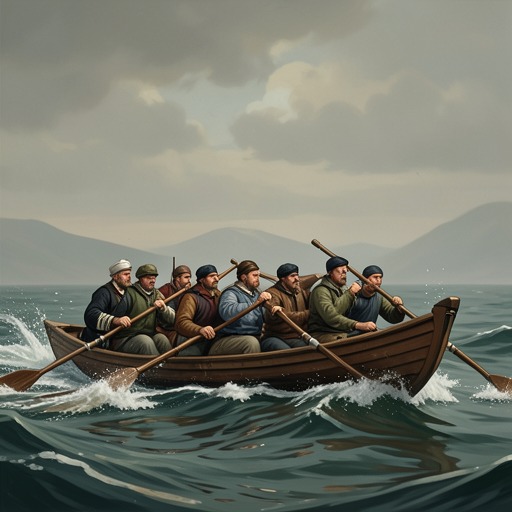
Conditions differed sharply between races. On August 12, the American crew’s preliminary heat took place in mild weather, with only a light following wind and calm water. They rowed in lane one, the most protected lane, although the conditions made the advantage less decisive. For the later race, rain continued and the lake was rough beneath a brisk wind. Gusts crossed the course erratically from the west. As the American boat rowed toward the exposed starting area, wind pushed against its bow and choppy waves struck its port side; members of the crew struggled to keep it aligned. Langer See was not merely a backdrop to the contest: the arrangement of its shore and the movement of its wind affected the boats’ handling and the terms of competition.
A Sporting Community Under Pressure
The lake’s longstanding convivial club life persisted in outward form after the Nazi Party came to power, but participation and belonging changed. Rowers still launched their shells on clear water, met after outings at local taverns, and gathered outside their boathouses while Olympic construction continued. Beneath those routines, Jewish members and clubs faced exclusion. The Jewish Helvetia Rowing Club had been banned in 1933; mixed clubs were threatened with dissolution unless they removed Jewish members from their rolls. Smaller Jewish clubs continued, but their existence and property depended on local Nazi officials, who could close them and confiscate their equipment.
The changes reached into everyday club relationships. Former crewmates turned away from one another; names disappeared from membership lists, signs appeared at boathouse doors, and locks and keys were changed. In the surrounding countryside, Jewish owners’ substantial homes were boarded up or rented to German families for a fraction of their value when their owners managed to leave the country. The contrast between the lake’s continuing sporting activity and the narrowing access to it makes the Olympic preparations part of a more complicated local history: facilities expanded as a community that had once shared the water was forcibly divided.
The Lake in Memory
The course drew a crowd of more than 75,000 for the Olympic rowing event, the largest audience ever to witness an Olympic rowing competition. From the terrace of Haus West, Adolf Hitler, Joseph Goebbels, and Hermann Göring watched the boats approach the finish. The lake and its facilities thus served an international sporting event and a public spectacle in which political leaders were themselves on display.
In 2011, the book’s narrator returned to Grünau, where the American rowers had won gold seventy-five years earlier. The finish area had a large electronic readerboard, but the covered grandstands and the course remained much as they appeared in photographs and newsreels from 1936. Young rowers still moved through lanes laid out for the Olympic races. From the balcony of Haus West, the narrator looked across the water from near the place where Hitler had watched the competition. Below, a crew prepared a shell for an evening outing, while a single sculler moved toward the finish. The present-day calm does not erase the lake’s history; it makes the persistence of the place, alongside the remembered competition and the broken club community, part of its significance.